When Congress Hallucinates
Google says the House held a hearing on public access to legislative data last week. It didn't. But the AI didn't make it up.
Last week, according to Google, a House subcommittee held a hearing on public access to legislative data. The AI-generated answer at the top of the search results describes it in the past tense. It referenced trustworthy sources like Congress.gov, the House Administration Committee’s “hearing hub,” even good ole C-SPAN.
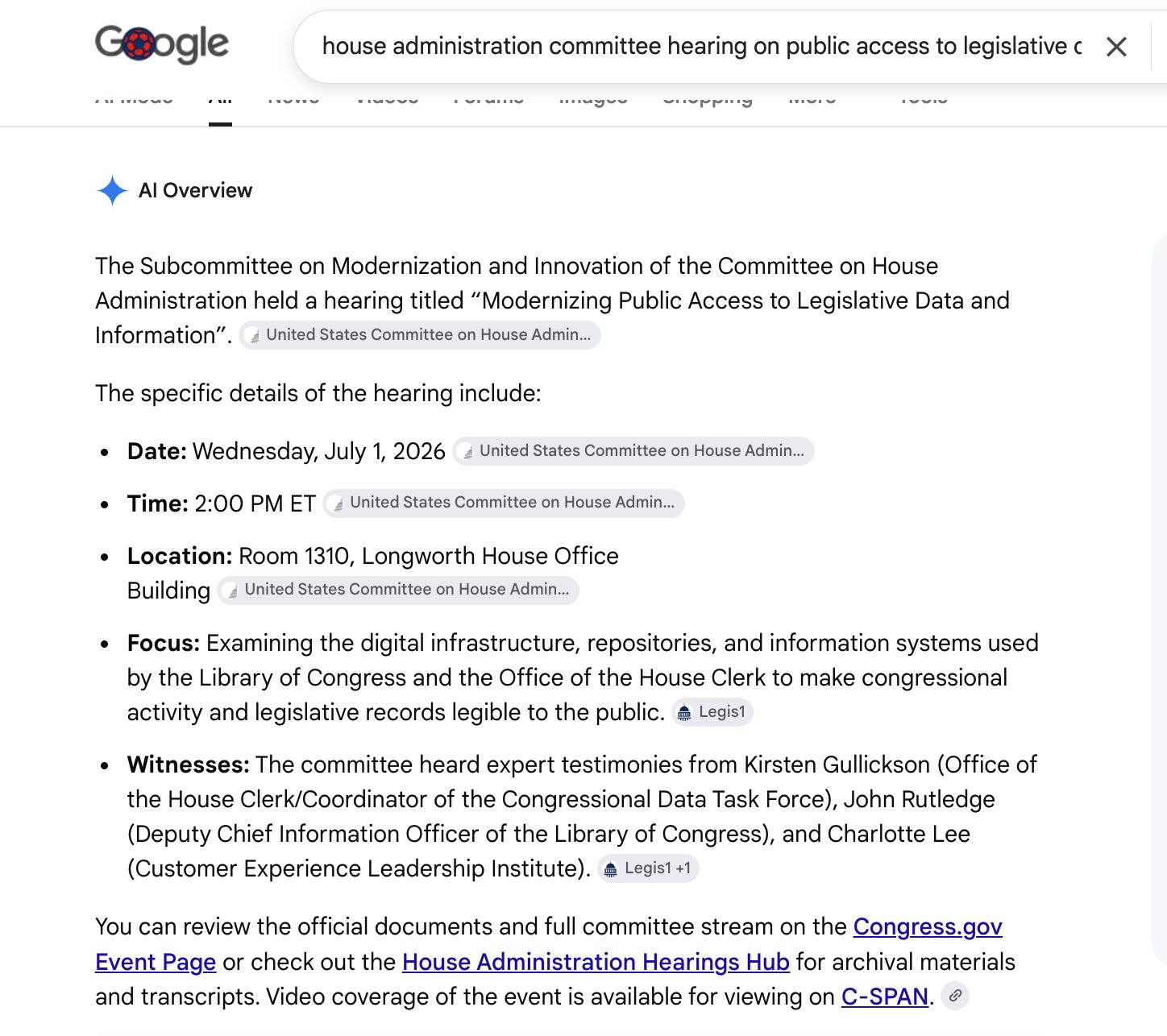
I only checked in at the end of a busy day. I meant to watch the hearing live but just couldn’t make it. And by the time I was looking for the video, I (a former Congressional staffer / certified Congress nerd who can usually always find the most arcane documents in the disconnected labyrinth of First Branch websites) could not figure out what happened.
I asked a frontier AI tool with live web access to confirm whether the hearing had taken place. It read the same sources everyone else does and told me, confidently, that it had.
But the hearing never happened.
Instead, the House canceled votes the day before and Members left town. (A common occurrence!) The witnesses Google named did not testify. The video it links to does not exist. A congressional hearing about public access to legislative information was called off, yet within hours, the Internet (citing public legislative information) produced a complete record of it occurring.
The reflexive explanation is that the AI “hallucinated.”
It didn’t.
Held and not held
For about a day, whether this hearing happened depended entirely on where you looked. It didn’t matter if you were human or machine.
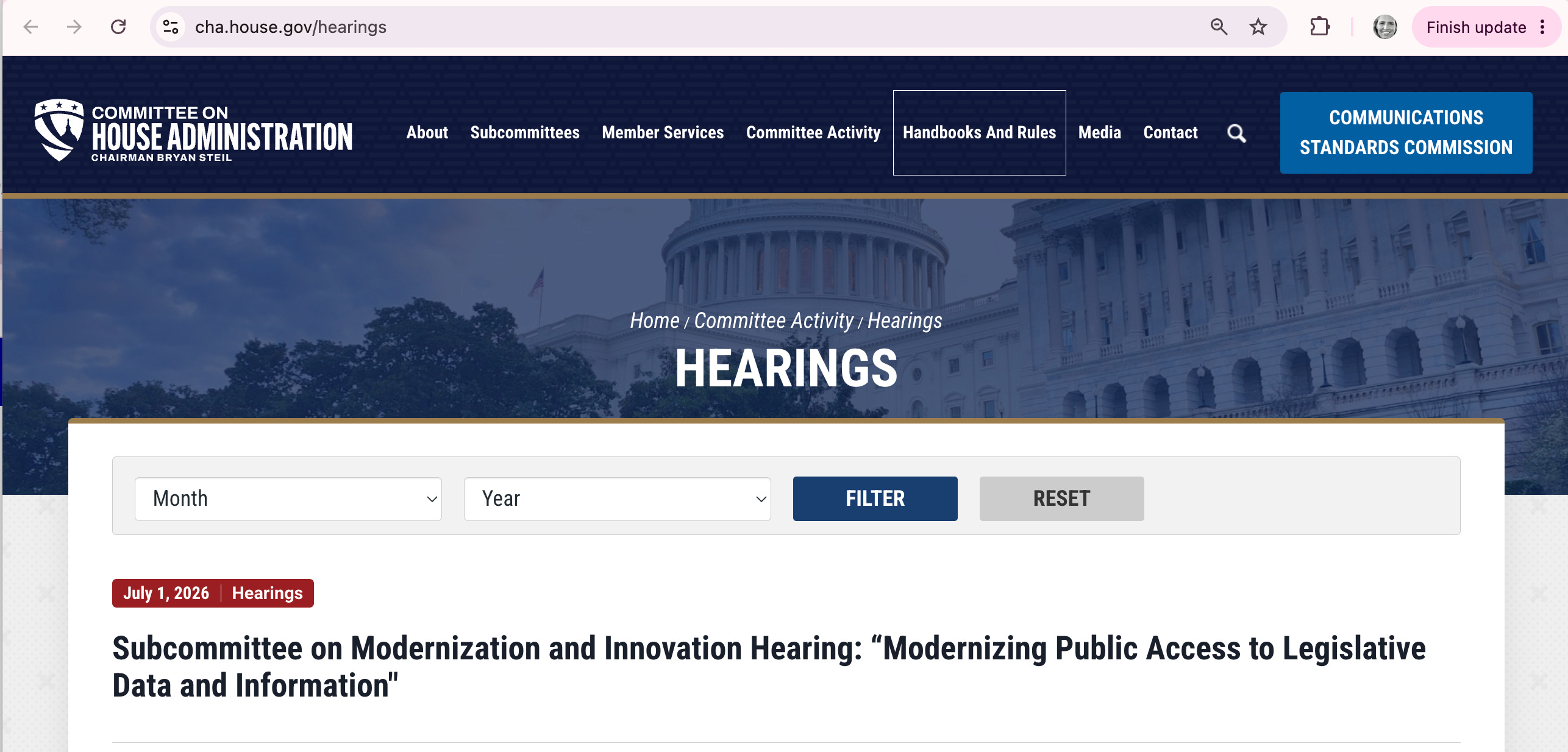
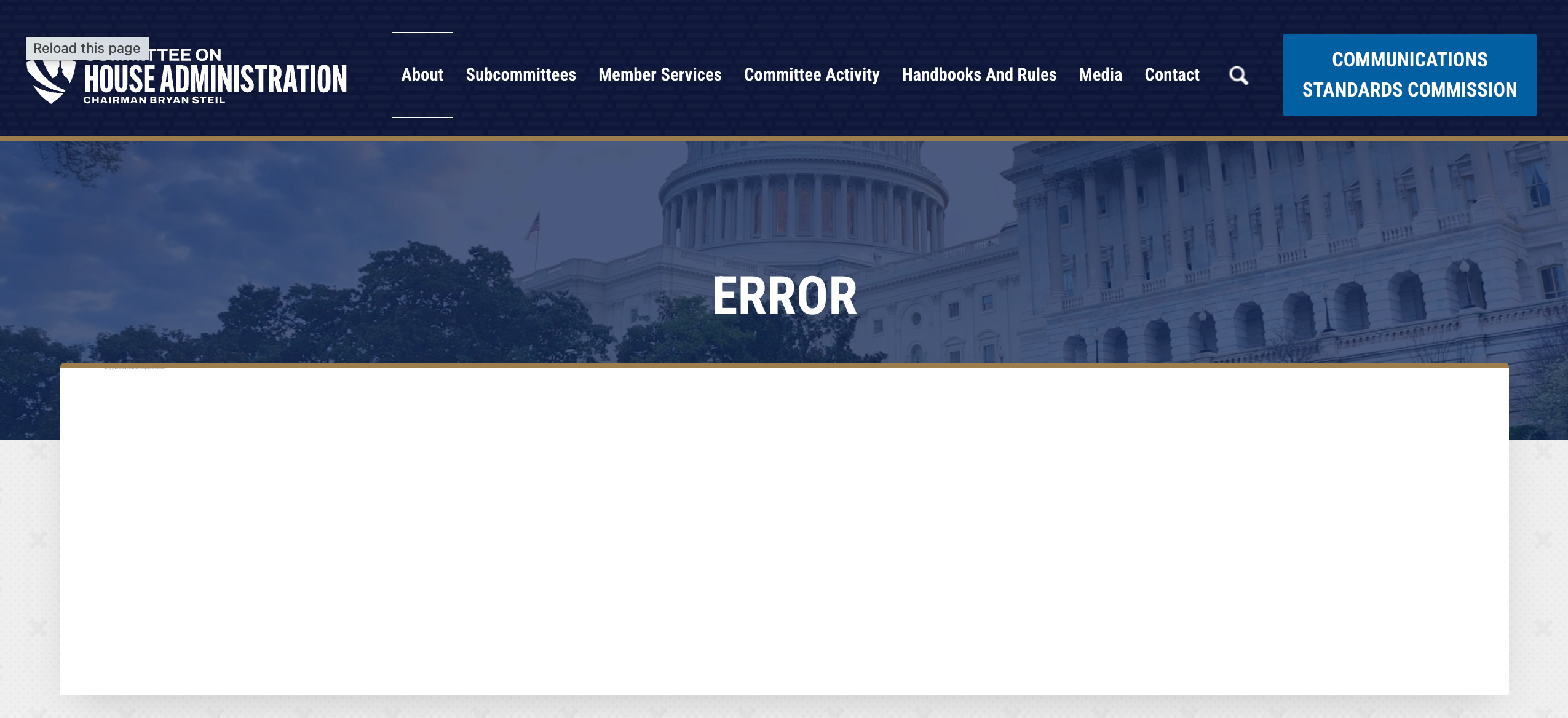
Days later (last checked July 7), the committee’s own website still listed the hearing on the original date, and clicking the link just produces an “error” page.
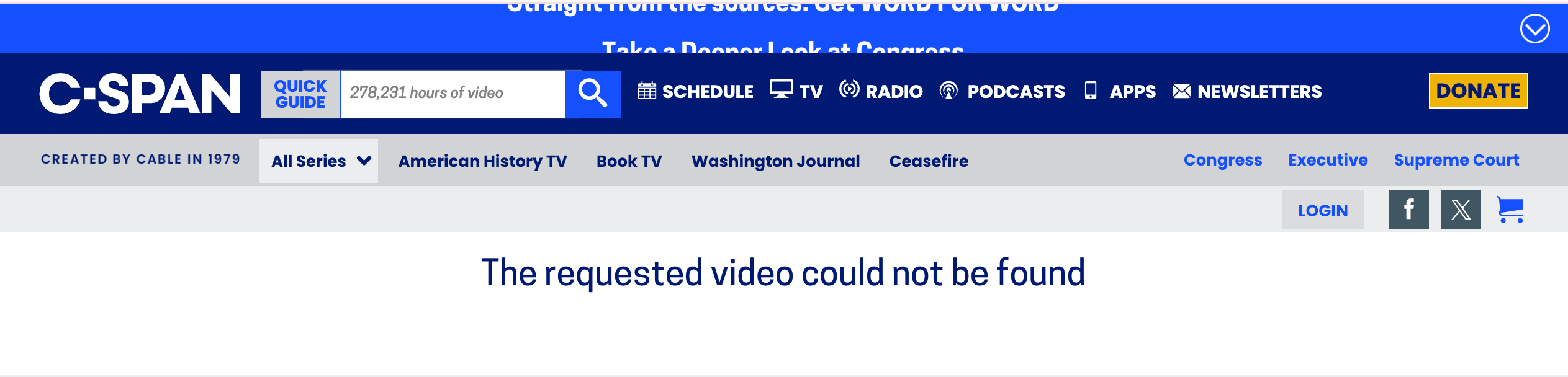
C-SPAN’s automated systems published a program page the day before the scheduled hearing, entitled “Library of Congress Adviser Testifies.” Nearly a week later, clicking the link offers no clue that the hearing did not actually occur, just that “the requested video cannot be found.”
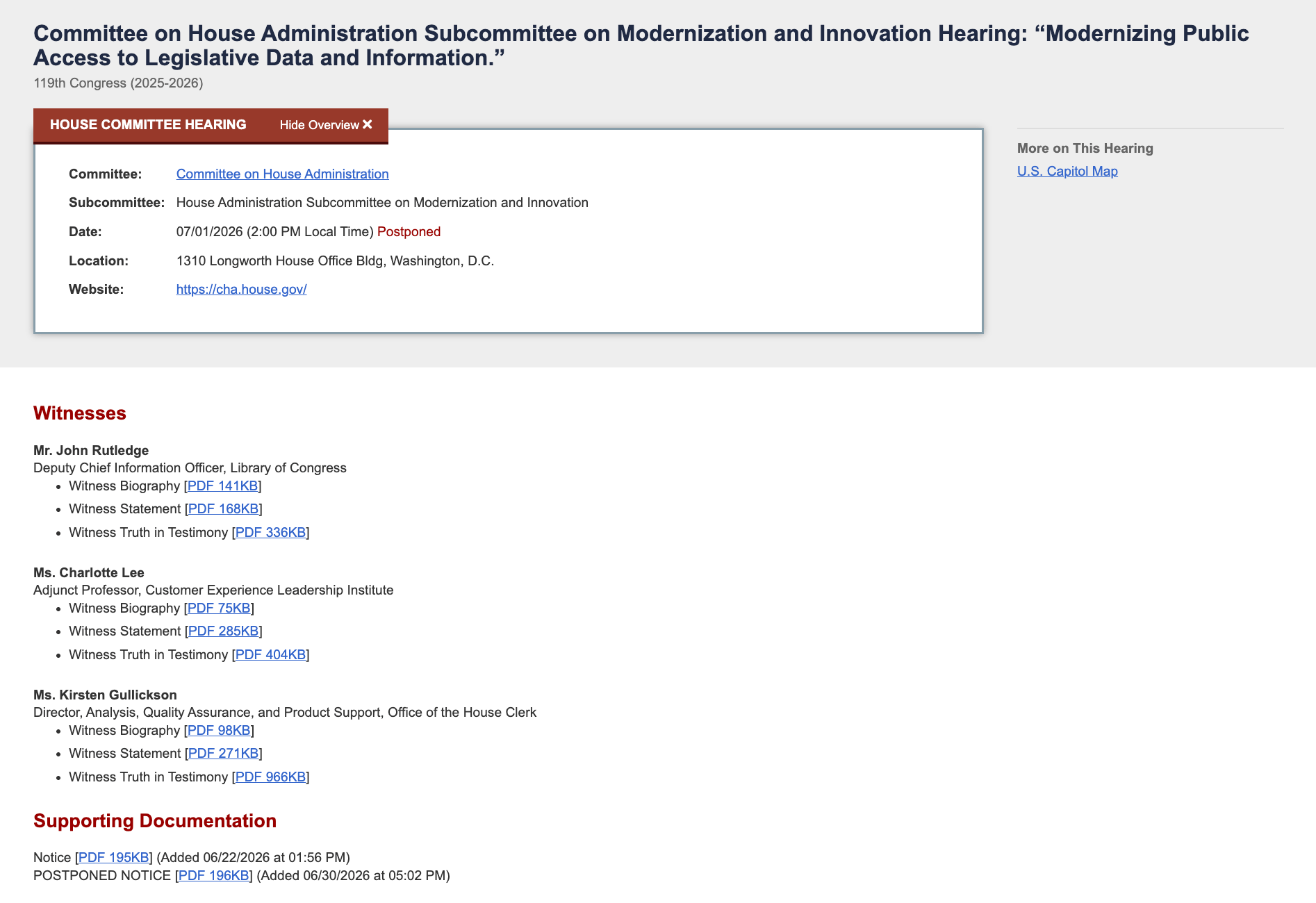
I ultimately figured it out when I clicked over to the House Committee Repository (which is not known for its friendly user experience). Only after navigating through the calendar and a “view more” that few would know to click, did I get a clue of what had happened: a new PDF link entitled “POSTPONED NOTICE” had been uploaded. That was it.

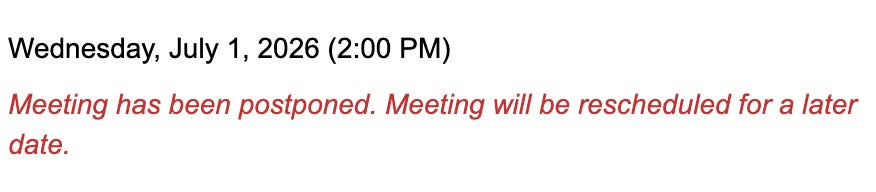
A few hours later (well into the evening) an explanation was added:
Around the same time, a similar (barely perceptible) tag showed up on Congress.gov:
Who’s hallucinating?
Both Google's AI-generated summary and the AI I consulted cited reputable sources. C-SPAN said witnesses “testified.” The committee’s own website said the hearing happened on July 1.
Members of Congress often raise concerns of “hallucinations” when discussing AI and public information. When this hearing finally does occur, AI hallucinations will almost certainly (and rightly!) come up. It is vitally important to ensure that AI systems do not misinform the public about Congress.
But this way-too-on-the-nose example raises an important issue when it comes to public access to legislative information. In many cases, it is Congress that can determine whether the information is available, accessible, and accurate.
AI companies can work to improve machines that hallucinate. They cannot fix it when Congress hallucinates. A perfectly accurate AI faithfully summarizing an incorrect official record will still mislead the public and no amount of model improvement, disclosure requirements, or watermarking will change that.
The rules were followed
The crazy thing is, the rules were followed. A hard fought rule adopted in 2011 requires at least a week of public notice of hearings. This hearing got nine days of notice. Testimony, witness biographies, disclosure forms were published, all by the book. Every requirement of public notice was fulfilled and it was completely inadequate.
At 5:02 p.m. the night before the hearing (within hours of the House canceling votes) someone on the staff of the Clerk of the House updated the official record by uploading that PDF. Status: postponed. Timestamped notice attached. Prompt, correct, exactly what the public would hope.
That completely responsible, appropriate staff action was not sufficient because almost no human could find it, and no machine could read it.** If you think the user experience for a human was bad, it was even worse for AI. The Committee Repository’s “download” link for the official file isn’t actually a link, it’s a button that only works if you’re a human sitting in a web browser. No search engine can reach it. No AI can read it. You can’t even bookmark it.
Why you should care
Most Americans will never visit a congressional website. That was the case over a decade ago when the Committee Repository launched. It is even more true today as people increasingly get their facts summarized and contextualized in Google results, AI chatbots, or apps that specialize in making complex information easier to understand.
We have reached the point at which the primary delivery mechanism for public access to legislative data is not a legislative website. Congressional policies — and technology — need to be updated to reflect that.
** Update, July 10: After this piece published, Daniel Schuman (who spent years advocating for committee data to be published as structured data, and knows this terrain as well as anyone alive) pushed back on one claim, and he’s right on the specifics. The meeting XML does live at a direct web address, and the Congress.gov API (which now shows the hearing rescheduled for July 21) carried the update as well.
I originally wrote that the file had no URL. It does have one BUT that address appears nowhere on the page. The only way to reach the file is a download button that works solely inside a live browser session or by guessing the filename from the Clerk’s internal naming conventions. The API, for its part, requires registered credentials that Google’s AI, C-SPAN’s automation, and consumer AI tools are not using and nothing on any House page points to it.
In other words: the truth was available to someone like Daniel Schuman, but not normal folks looking for an update or the machines that are increasingly mediating Americans’ questions about their government. The hard-fought open gov wins of the past were significant, and they opened government data to experts, who, through their own initiative (often with very little funding or resources) helped explain the inner workings of gov to the public. Just as Daniel and others argued for moving beyond “technically open but inaccessible” in-person reviewable files, locked PDFs, and other unstructured data to get to the APIs and bulk data downloads of yesterday, “open data” today requires methods built for how the public actually gets information: addresses machines can find, statuses they can read, records that keep their own history.
Big thanks to Daniel for continuing to carry the torch!
Marci Harris is Co-founder and CEO of POPVOX, Inc. and Executive Director of the POPVOX Foundation, which works on congressional modernization and legislative technology. She is a former congressional staffer and an incoming Futures Fellow at the Harvard Kennedy School’s Ash Center for Democratic Governance and Innovation.